| Audible alarm, display shows a temperature-zone code, fresh-food compartment warm |
Evaporator fan motor; damper actuator; defrost heater |
Calibrated thermometer in both compartments; listen for fan spin; check evaporator for frost block |
Thermistor returning a false high reading when compartment is actually in spec — confirms with meter, not touch |
Fan or heater replacement if confirmed; defrost forced cycle if frost-blocked; thermistor swap if resistance is out of spec |
| Continuous tone, all compartments at normal temperature, alarm clears when door is touched |
Door gasket; door hinge alignment; door not fully latched |
Dollar-bill drag test along full gasket perimeter; check hinge gap; confirm door latch engages |
Alarm wiring fault that clears intermittently — does not correlate with door position; requires board inspection |
Gasket replacement if compression-set or torn; hinge adjustment if door is pulling out of square; see gasket repair page |
| Display shows a sensor or thermistor fault code, compartment temperature appears normal |
Fresh-food or freezer thermistor; thermistor wiring harness |
Measure sensor resistance (ohms) at ambient temperature; compare to model-specific chart — do not use a generic NTC table |
Genuine temperature deviation masked by a misfiring sensor — thermometer reading in compartment is the ground truth |
Thermistor replacement with OEM component matched to model; wiring harness inspection if resistance reads open or shorted |
| Alarm with a communication or board fault indication, unit behavior erratic or unresponsive to panel input |
Main control board; user interface board; interconnect wiring |
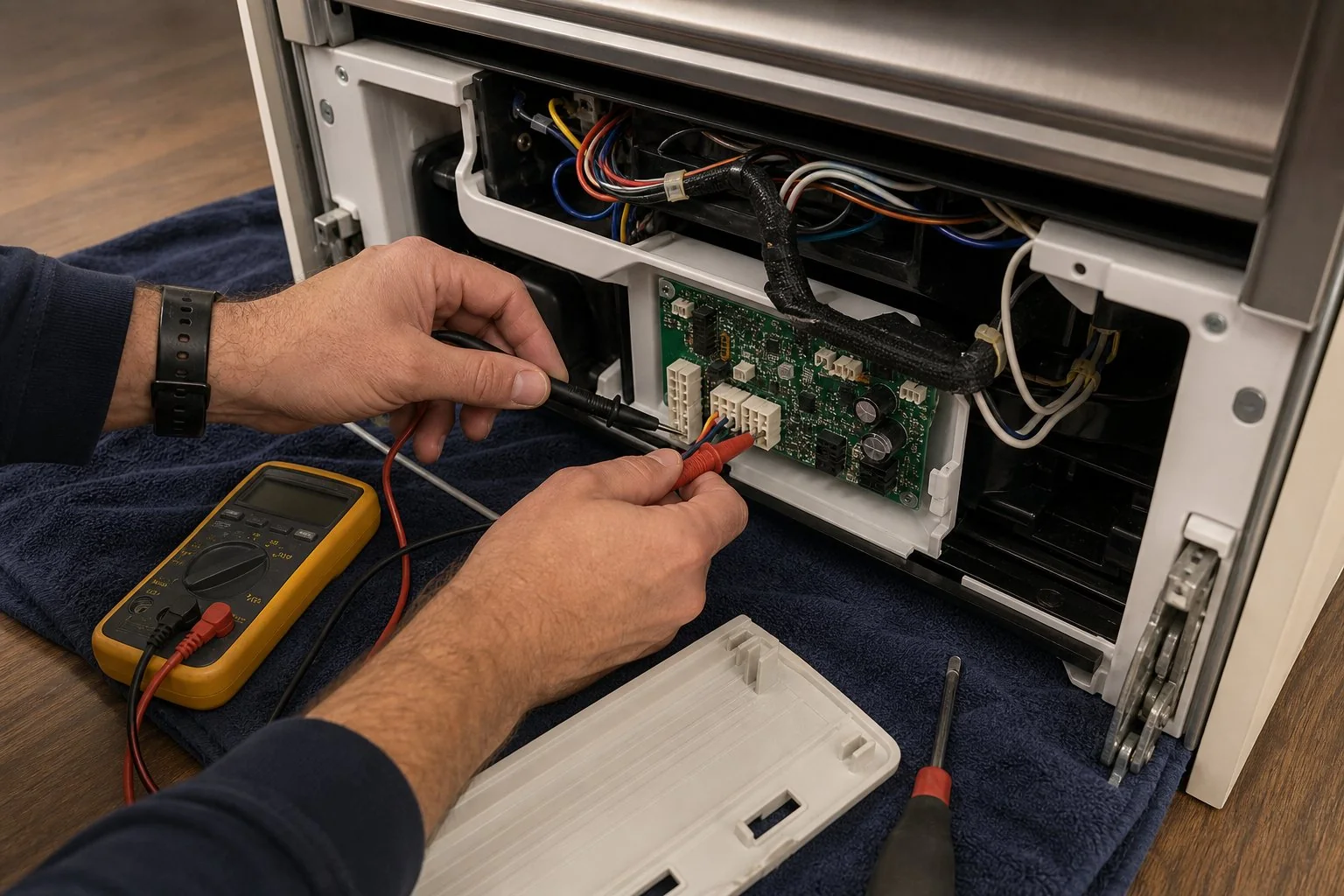
Controlled power cycle first; if fault returns, test voltages at board connectors and inspect for corrosion or burned traces — requires meter and schematic |
Power-event latch (brownout or surge) that clears with power cycle and does not return — replace nothing until fault is confirmed persistent |
Board replacement only after fault is confirmed isolated to that board; address power-quality issues (surge protection) before repair |
| Freezer compartment alarm, ice maker stops producing, no harvest cycle audible |
Ice maker module; harvest thermostat; water inlet valve; ice maker thermistor |
Check harvest thermostat continuity; verify water inlet valve opens on call; inspect mold thermistor resistance; confirm supply line pressure |
Arm in the off (raised) position — the simplest false alarm; check arm position before any electrical testing |
Module replacement if harvest thermostat and wiring test normal and cycle still fails; see ice maker & water line page |
| Alarm after a power outage or brownout, unit otherwise functioning normally |
Control board fault latch; surge/brownout residual state |
Unplug unit for two minutes; restore power; observe whether alarm returns and whether temperatures hold |
Treating a latched code as an active hardware fault — ordering and swapping a board for a brownout artifact is a common costly error |
If alarm clears and temperatures hold: add surge protection and monitor. If alarm returns: proceed to board and sensor verification by model |
| High-temperature alarm in condenser zone, unit running continuously, compressor audibly hot |
Condenser coil (dust-blocked); condenser fan motor; ambient temperature too high around unit |
Inspect condenser coil for dust loading; test condenser fan RPM and amperage; verify clearance around unit meets installation spec |
Ambient heat event (kitchen remodel, summer heat spell) that resolves on its own — confirm condenser temperature drops after coil cleaning before assuming fan failure |
Condenser cleaning; fan motor replacement if coil is clean but fan is slow or stalled; verify installation clearance; see not-cooling diagnostic |