Sub-Zero Not Cooling in Novato — Fresh-Food Warm, Freezer Warm, or Both
4.9 network rating264 verified Sub-Zero repairs across our Bay Area service network
Direct answer
A Sub-Zero that stops cooling in Novato falls into three patterns: fresh-food compartment warm while the freezer holds, freezer warm while the fresh-food side still chills slightly, or both compartments drifting together. Each pattern points to a different root cause. The most common finding on both-compartment drift — especially in newer homes here and over toward Larkspur — is a condenser coil packed with dust or pet hair that can no longer reject heat efficiently. The most common split (fresh-food warm only) usually traces to the evaporator fan or a defrost fault. We triage by reading temperatures and inspecting hardware before quoting anything. Call (415) 683-1487 and have your model number ready — it changes which parts we bring.
There is a related concern worth flagging on Novato's Sub-Zero built-ins specifically: the built-in cabinet removal and reseat risk. These units are framed flush with stone or cabinetry, and pulling one incorrectly to access the condenser damages the finish or the opening. We plan cabinet access before we start rather than improvising on site. In homes around ZIP 94945 — where 600-series units in estate kitchens are common — we've found that a tight, poorly ventilated toe-kick cavity accelerates condenser loading dramatically compared with units in more open installations.
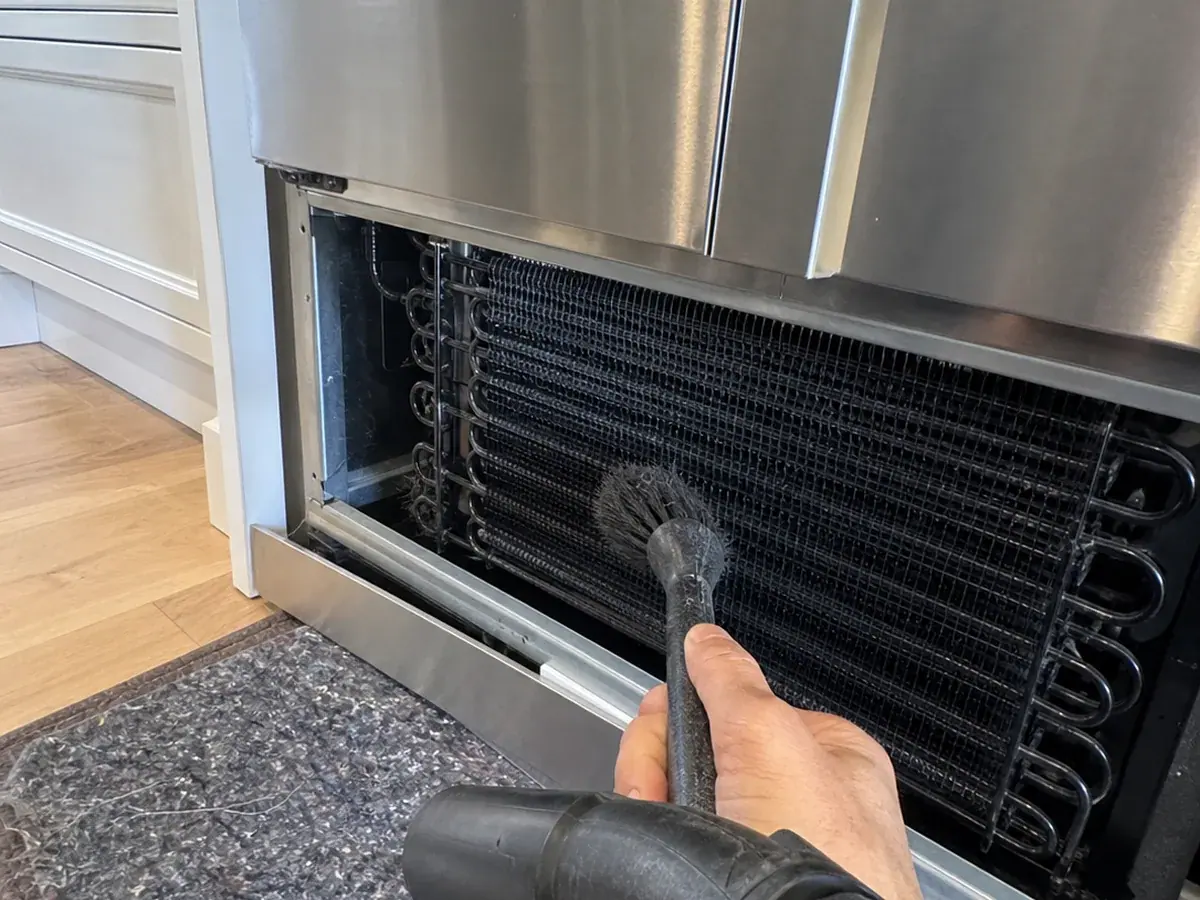
Condenser airflow confirmed by service photo. The grille is opened, the coil face is cleaned, and return/discharge airflow is checked before sealed-system work is considered.
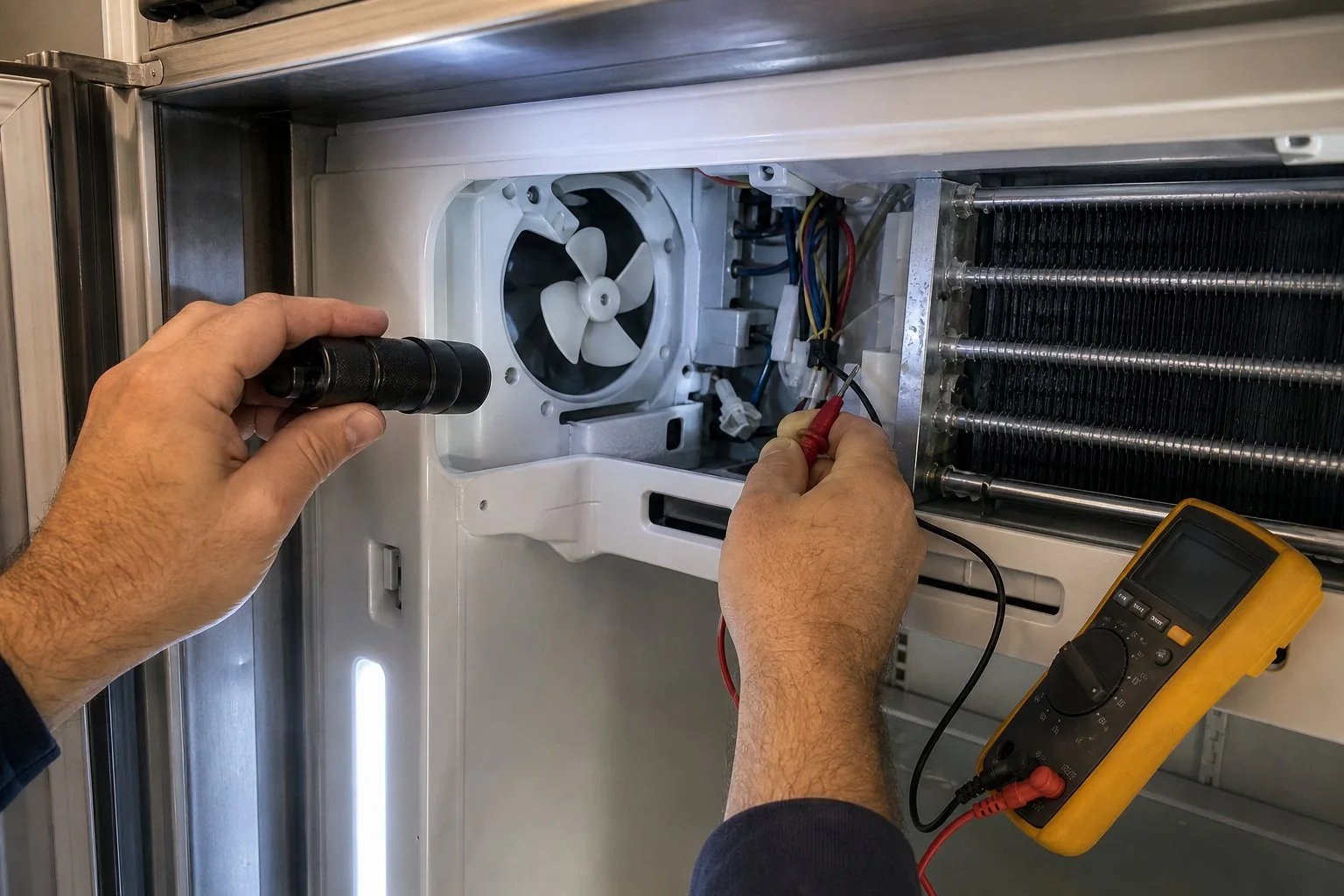
Not-cooling diagnostic. A fresh-food section that drifts warm is checked at the evaporator fan, airflow path, and compartment temperature log before sealed-system conclusions.
Why is my Sub-Zero not cooling in Novato — fresh-food warm, freezer warm, or both?
When a Sub-Zero quits cooling in Novato, including the Ignacio neighborhood near ZIP 94945, the fault falls into three shapes: fresh-food warm, freezer warm, or both compartments drifting at once. We log actual temperatures and inspect the condenser first. Call (415) 683-1487 to book your diagnosis.
What each not-cooling pattern means — and what to do right now
Fresh-food warm, freezer still cold
This split usually means the freezer coil is still chilling, but something has interrupted airflow into the fresh-food section. A failed or seized evaporator fan motor is the most common mechanical culprit. A plugged defrost drain that has iced over the evaporator — blocking airflow entirely — is the second. The damper that regulates air between sections can also stick closed. What is normal: a brief cycle where the fresh-food section climbs a few degrees while the compressor rests. What is abnormal: fresh-food section above 45°F with the freezer still at or near 0°F.
Less common and more concerning. The freezer requires the coldest temperatures and is the first to reveal refrigerant loss or compressor weakness. A thermistor reading the wrong temperature can also cause the control board to under-run the compressor. This pattern warrants a prompt call — food in a drifting freezer is a loss risk.
Both compartments warm — condenser coil dust
When both sections drift together, the refrigerant loop itself is compromised at some point. The overwhelmingly most common cause we find in Novato: a condenser coil matted with dust, pet hair, and Marin fog debris that can no longer move heat out of the unit. The coil sits behind the toe-kick grille or upper grille depending on the series, and it loads progressively — no single dramatic failure, just a unit that runs longer and longer until both compartments stop holding temperature. What confirms it: visible mat on the coil fins, elevated discharge temperatures, and temperatures that begin recovering within 24–48 hours after a thorough cleaning. The honest limitation: if both compartments fail to recover after cleaning and fan verification, the problem is deeper — the sealed system, compressor, or start components — and that requires an on-site diagnosis with meters.
When to stop using the unit
Once the fresh-food compartment has risen above 40°F for more than two hours, perishables in the food-safety danger zone should be removed. Keep the doors closed as much as possible — every opening exchanges cold air for warm, humid air. The unit itself will not be further damaged by running, but there is no benefit in waiting to schedule the diagnosis.
Condenser airflow confirmed by service photo. The grille is opened, the coil face is cleaned, and return/discharge airflow is checked before sealed-system work is considered.
Cause ranking
Likely causes — simplest to most involved
Condenser coil dust / pet hair Most common
Signs
Both compartments drifting; unit runs nearly constantly; top grille emits heat that feels excessive to the touch; visible mat visible through the grille with a flashlight.
Test
Inspect coil face with a flashlight and stiff card; measure compartment temperatures after cleaning; re-check 24 hours later.
Typical repair
Professional coil cleaning, fan blade inspection, re-test. $95–$145 diagnostic; cleaning often included. No parts cost if the fan tests good.
Door gasket leak / condensation / frost line Common
Signs
Condensation beading on the door frame or interior liner near the hinge side; visible frost band along the gasket path; fresh-food section warmer than the back-of-compartment reading; gasket feels soft or shows a permanent compression groove.
Test
Dollar-bill drag test at four points around the perimeter; visual inspection for a gap or flattened lip; door-swing check for hinge sag that pulls the door out of plane.
Typical repair
Gasket replacement (OEM profile for the specific series); hinge adjustment if needed. Parts $200–$400 depending on the model and gasket count. Hinge work may add labor.
Fresh-food section warm while freezer holds near target; no airflow felt at the fresh-food vents; unit may be quieter than usual (fan not running).
Test
Listen at fresh-food vents; access evaporator compartment, spin blade by hand (seized = no free rotation); measure motor winding resistance.
Typical repair
OEM fan motor replacement. Parts $200–$450 depending on the series. Usually a one-trip repair if the motor is confirmed by model number in advance.
Defrost system fault (heater / thermostat / board) Common — progressive
Signs
Evaporator iced over; reduced airflow through the system; unit cools initially after a manual defrost (unplugging for 24 hours) then drifts again within days.
Test
Inspect evaporator for solid ice sheet; measure heater continuity; read defrost cycle via service mode if the board supports it.
Typical repair
Defrost heater, limit thermostat, or control-board defrost-logic repair. Parts $200–$500. Board replacement varies by series — confirm OEM part availability first.
Sealed system / refrigerant / compressor Most involved
Signs
Both compartments warm and all simpler causes have tested clean; compressor runs but suction and discharge temperatures are abnormal; or compressor does not start at all.
Test
Pressure testing under EPA-certified handling; compressor amp draw; evaporator frost-pattern analysis; ruled in only after condenser, fan, defrost, and gasket are cleared. The technicians who run this test hold Section 608 Universal certification — the refrigerant rules, year by year show why that has been the legal requirement since 1994.
Typical repair
Sealed-system work starts at $1,500 and depends on the specific fault and refrigerant type. We confirm the diagnosis and show you the evidence before this goes on the table.
How Novato's environment accelerates not-cooling faults
Most of the not-cooling calls we handle fall within ZIP 94945 — the newer subdivisions along Novato Boulevard and the Rowland corridor, where 600-series units are common and condensers are often tucked into tight cabinetry with minimal clearance above the toe-kick. That combination — dense residential use, pets, and restricted airflow — loads a condenser faster than Sub-Zero's maintenance schedule anticipates. If your unit is in that part of town and hasn't had its condenser cleaned in more than 18 months, the coil is likely the first place to look.
The older neighborhoods in ZIP 94947 — Hamilton and points south toward Ignacio — see a different pattern: 500-series units that are 15-plus years old, where door gaskets have taken a permanent compression set and door hinges have drifted enough to break the plane of the seal. The symptom reads as a not-cooling complaint, but the root cause is a door gasket leak, condensation or frost line that has forced the compressor to run nearly continuously. Fog cycling through the salt-air corridor along the bay also accelerates gasket swelling in these homes — a humidity and material problem as much as a mechanical one.
Neither ZIP is worse than the other; the failure modes are just different, and the repair plan needs to reflect them. We identify which pattern applies in the first 15 minutes on site.
Recent jobs
What a not-cooling call looks like in Novato
Three recent Sub-Zero not-cooling calls around Marin — the symptom we heard, what we found, and how the temperatures were verified before we left.
600-series built-in — both compartments warm Bel Marin Keys
Symptom reported
Homeowner noticed food spoiling; display read 38°F but a thermometer placed inside showed 52°F fresh-food, 18°F freezer.
Finding
Condenser coil face fully matted with pet hair and fine dust. Fan motor tested good. Coil cleaned; discharge temperatures dropped within two hours.
Outcome
Temperatures returned to within 2°F of setpoint by the following morning. No parts required. Diagnostic fee applied.
Fresh-food section consistently 50–55°F over three days; freezer at 5°F. Unit running; no unusual noise.
Finding
Evaporator fan motor seized — blade turned freely when the motor was powered down, but the motor would not start under load. Defrost heater tested within spec. OEM fan confirmed by model number before the call.
Outcome
Fan motor replaced same visit. Fresh-food compartment recovered to 37°F within four hours. Gasket also showed early compression set — flagged for the owner's awareness.
700-series column — intermittent cooling, frost at door frame Pacheco Valle
Symptom reported
Unit cooled unevenly; noticeable frost line at the hinge side; owner thought it needed refrigerant.
Finding
Door gasket leak confirmed by drag test and infrared reading at the seal — warm air infiltration was forcing near-constant compressor cycling. Hinge pivot had shifted 3mm out of plane. Sealed system pressure tested normal.
Outcome
Gasket replaced with OEM profile; hinge adjusted; compartment stabilized. Avoided an unnecessary sealed-system quote.
Typical cost ranges for a not-cooling Sub-Zero in Novato
Not-cooling prices depend on which pattern the unit shows: fresh-food only, freezer only or both compartments. The ranges below match the faults most often found in Novato 94945, 94947 and 94949 homes.
Not-cooling price table for Novato Sub-Zero built-ins
Service / symptom
What is included
Price range
Typical timing
Warm fresh-food side, freezer holds
Evaporator fan, damper and defrost checks; OEM fan if confirmed
$295-$575
2-4 hr
Both compartments warm, unit loud
Condenser cleaning, fan amp/RPM test, 24-hour recovery guidance
$165-$345
1-2 hr
Frost line or condensation at door
Gasket compression test, hinge check, OEM gasket if needed
Calibrated temperature log, resistance check, OEM sensor replacement
$235-$430
1.5-3 hr
Confirmed sealed-system fault
EPA-certified pressure test, leak search and written repair quote
$1,650-$3,350+
1-2 visits
The final cost is determined by the measured temperature pattern, not the word 'warm'; the freezer/fresh-food split decides the diagnostic path.
Citable fact
A Novato Sub-Zero with fresh-food above 45°F while the freezer is near 0°F usually points to airflow or defrost, not the compressor.
Cost anchor
Most not-cooling repairs in Novato that do not open the sealed system fall between $235 and $650.
Evidence, not assumptions
How we document the diagnosis — and why it matters
Every not-cooling call produces a documented evidence trail before any repair quote is given. That means: calibrated temperature readings from both compartments (not the front display — a probe placed inside), photographs of the condenser and evaporator showing coil condition and frost pattern, the model-tag photo confirming the exact series and build date so OEM part numbers are pinned before ordering, and where the fault points there, OEM fan motor, gasket, or control-board evidence — winding resistance readings, continuity checks, board fault codes — that explain why a specific component is the correct fix.
If the diagnosis points to a door gasket leak, condensation or frost line as the primary driver, the documentation includes the drag-test result, the infrared or thermometer differential at the seal, and the hinge-alignment measurement. If it points to the sealed system, we show pressure readings and compressor behavior — EPA-certified work that we do not start without confirmed authorization. What we don't do is quote a $1,500 sealed-system repair based on a warm unit and an assumption.
Pricing ranges — confirm by phone
Diagnostic: $95–$145 (credited to the repair). Common parts such as fan motors, gaskets, thermistors: $200–$650 depending on the series. Sealed-system work: $1,500 and up, confirmed with evidence before any commitment. No fixed pricing is given sight-unseen.
Book a Sub-Zero-specific diagnosis
Call with your model number and a description of which compartment is warm — or both. We'll tell you what the most likely cause is for your series and what parts we'd plan to bring. Mon–Sat 7:00am–7:00pm. Honest diagnosis first.
Common questions about Sub-Zero not cooling in Novato
My Sub-Zero fresh-food section is warm but the freezer still seems cold - what causes that in Novato?
That split most often means the freezer coil is still cold but air is not reaching the fresh-food side. In Novato homes, the usual causes are a failed evaporator fan, a stuck damper or a defrost fault that ices the coil. A compressor is not the first suspect when the freezer still holds near 0°F.
Both compartments are warm in my 94945 kitchen - where do I start?
Start with the condenser. If both sections drift together, a condenser coil packed with dust, pet hair and fog-borne debris is the most common Novato finding. A proper clean and fan check runs about $165-$345 when no parts are needed. If temperatures do not recover after that, the fan, start components and sealed system are tested.
Can a gasket leak make only one compartment run warm?
Yes. A failed fresh-food gasket can pull humid room air into that compartment while the freezer still looks normal. Look for condensation, a frost line at the door perimeter or a weak bill-drag test. Gasket and hinge repairs typically run $285-$650, depending on whether the panel-ready door needs alignment.
When is a not-cooling Sub-Zero too far gone to repair?
The hardest case is a confirmed sealed-system failure on a unit older than 20 years, especially if a compressor or evaporator is involved and the kitchen is already due for a remodel. A younger built-in with a fan, gasket, defrost or thermistor fault usually favors repair because replacement plus Marin cabinetry can reach $13,500-$23,500.
Is it safe to keep food in a Sub-Zero that is drifting warm?
If the fresh-food compartment is above 40°F for more than two hours, perishables are in the food-safety danger zone. Move dairy, meat and leftovers out, then keep the doors closed. The appliance is not usually damaged by a short warm run, but every door opening adds humid air and makes the diagnosis messier.
Do you carry parts for not-cooling calls in Novato?
For common Novato not-cooling calls we normally stock condenser fan motors, evaporator fan motors, thermistors, defrost components and common 500/600-series gasket profiles. Control boards and specialty column parts depend on the model tag. Sending that tag before the visit tells us whether the likely repair can be completed in one trip.
Reviews 4.9 average across our Bay Area Sub-Zero network
What Novato owners say after a not-cooling call
★★★★★
“After a foggy weekend our 632 was 51°F up top and only 16°F in the freezer. He found the condenser face caked with pet hair, cleaned it, and confirmed the fan amperage was back in range. Fresh-food side reached 38°F by morning — no parts needed, just an honest cleaning.”
Verified customer
Maria L., Meadow Park
★★★★★
“Fresh-food hovered around 52°F while the freezer held 4°F in our Hamilton townhome. He pinned it on the evaporator fan motor, replaced it, double-checked the defrost heater while he was in there, and logged 37°F at the center shelf before he’d call it done.”
Verified customer
Mark L., Hamilton
★★★★★
“Our 700-series column had a frost line right at the hinge and wouldn’t cool below 46°F. Rather than reaching for refrigerant, he measured a gasket gap and about 3 mm of hinge sag, fitted the OEM seal and squared the door. No sealed-system work at all.”