Skip to content
Novato Sub-Zero repair logo Sub-Zero Cold-Side ServiceAppliance Service Group of Novato · Marin / North Bay (415) 555-0125 (415) 683-1487

Home / Sealed System & Compressor

Technical diagnosis · sealed refrigeration circuit

Sub-Zero Sealed System & Compressor Diagnosis in Novato

4.9 Google rating47 reviews from Novato & Marin homeowners
Direct answer

When a Sub-Zero built-in in Novato develops a door gasket leak, condensation or frost line at the opening — or when temperatures drift without an obvious mechanical cause — the sealed circuit becomes a diagnostic candidate. That suspicion does not become a conclusion until refrigerant pressures, compressor amperage, and evaporator frost pattern are measured on site. In the Historic Old Town corridor near Grant Avenue, where remodeled kitchens sometimes hold older built-ins in tight, original cabinet openings, a call to (415) 683-1487 with your model number gets the right test equipment on the truck.

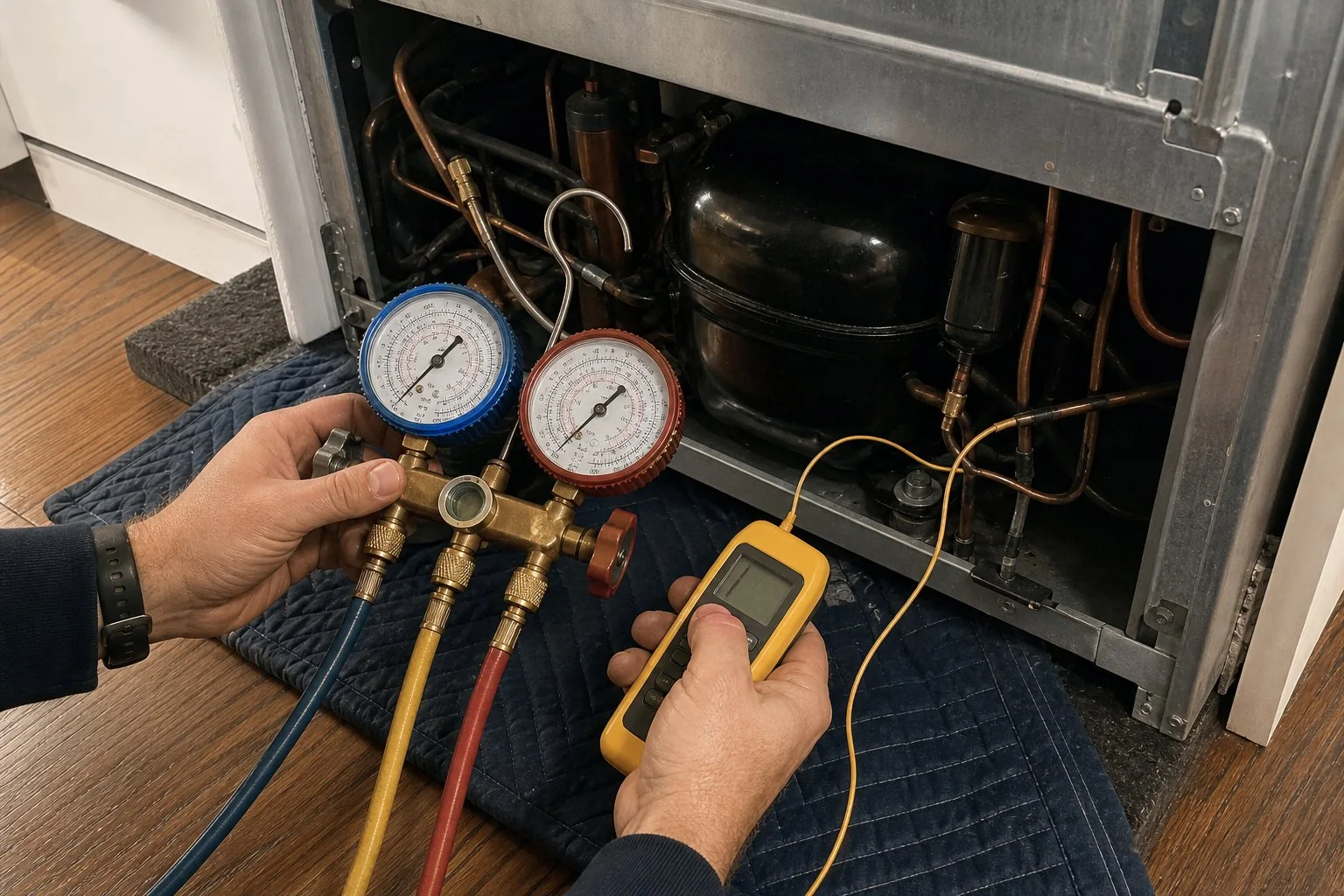
A sealed-system suspicion that needs EPA-certified verification is the most consequential and most frequently misattributed fault on a Sub-Zero. The sealed circuit — compressor, condenser coil, metering device, and evaporator — is a closed loop. When it fails or leaks, refrigerant capacity falls, the unit runs continuously, and compartment temperature rises in a pattern that mirrors several cheaper faults. What diagnosis confirms: suction and discharge pressure at the service ports, compressor start-relay and capacitor condition, LRA (locked-rotor amperage) draw, and evaporator frost-boundary position. The honest limitation: refrigerant pressure testing requires access to the rear base panel and, on many built-ins, partial cabinet clearance. Until access is established on site, no sealed-system verdict is possible from a phone call.

Technician hands using manifold gauges and a meter near the compressor area of a built-in refrigerator.
EPA-sensitive diagnosis. Compressor and refrigerant conclusions come after pressure, frost-pattern, airflow, and electrical evidence.

Scope of work — homeowner vs. technician

What a homeowner can safely observe — and where to stop

Do not attempt: refrigerant, compressor terminals, or control-board power circuits

Opening the sealed system without EPA Section 608 certification is a federal violation. Probing live compressor terminals (240 V in many Sub-Zero built-ins) without isolated test leads and correct technique is a shock hazard. Control-board replacement without verifying the fault code and ruling out upstream causes — thermistors, fan, sensor harness — wastes a board and may not fix the problem. If the refrigerant circuit or any live electrical component is involved, the job belongs to a trained technician with the correct meters and certification.

These are the observations a homeowner can make safely and usefully before a visit:

  • Compartment temperature: Place a calibrated thermometer (not the front display) in each zone and log readings every 30 minutes for two hours. Note whether the temperature is rising, stable, or oscillating.
  • Compressor run time: Listen at the rear base. A compressor that runs without pause for more than 45 minutes in a stable room is a documented symptom — not a diagnosis.
  • Door gasket compression: Run your hand along the full perimeter of the closed door with the light off inside. Warm air at any point indicates a seal gap. A dollar-bill drag test (close the door on a bill; it should offer resistance) identifies weak zones.
  • Frost line on the evaporator: With the unit powered and a flashlight, look through the interior back wall vents for uneven frost — a band of frost on only the upper or lower half of the evaporator suggests a metering or refrigerant issue, but this is an observation to report, not a conclusion to draw.
  • Model and serial number: Photograph the tag (behind the grille or on the upper interior wall). The sealed-system specification — refrigerant type, charge weight, compressor model — is pinned to that tag.

Field reference

Sealed-System Diagnostic Decision Table

Symptom-to-component mapping for Sub-Zero sealed circuit and compressor faults — Novato field reference
Symptom observed Possible component Confirmation test False-positive to avoid Repair path
Both zones warm; compressor runs continuously but produces minimal head pressure Refrigerant loss (leak or undercharge) Suction/discharge pressure at service ports; compare to spec by model/serial (verify by model/serial — do not use generic values) Dirty condenser; condenser fan failure — rule these out first as they produce the same surface symptom EPA-certified leak search, repair, evacuate, recharge to OEM specification; sealed-system estimate $1,500+, confirm by phone
Compressor does not start; clicking sound at startup then silence Start relay or overload protector Remove relay, shake — rattling indicates failed relay. Resistance check per OEM spec (verify by model/serial). Replace relay and retest before assuming compressor failure. Assuming compressor failure; start relay is a $30–$60 part that mimics a dead compressor exactly OEM start relay replacement; retest under load. If compressor still won't start after confirmed relay, proceed to LRA test.
Compressor starts, runs, but LRA exceeds rated draw; breaker trips or thermal overload opens Mechanically seized or winding-shorted compressor Clamp-meter LRA measurement at startup; compare to nameplate rating (verify by model/serial). Winding resistance check across terminals. Run capacitor failure causes high amp draw on single-phase motor; test and replace capacitor before condemning compressor Compressor replacement (OEM or approved equivalent); EPA evacuation and recharge; sealed-system labor applies
Fresh-food zone warm; freezer zone normal or slightly warm; evaporator frost only on lower half Restricted metering device or partial refrigerant loss Evaporator inlet and outlet temperature differential; frost-line boundary inspection; suction pressure reading Defrost system failure producing similar frost pattern; defrost heater continuity and defrost thermostat must be confirmed normal first If metering device restricted: sealed-system access, flush, component replacement, recharge. If defrost: heater or thermostat replacement only.
Continuous condensation or frost accumulation at door perimeter; compressor runtime elevated Door gasket leak (indirect sealed-system load) Dollar-bill drag test at gasket perimeter; infrared thermometer scan of door frame; compartment humidity observation Attributing elevated compressor runtime to refrigerant loss when a compromised gasket is loading the circuit — gasket costs a fraction of sealed-system work OEM gasket replacement in correct durometer and profile (verify by model/serial); door hinge and cabinet alignment check before condemning gasket alone
Compartment temperature rises slowly over days; unit eventually stabilizes at elevated temperature Slow refrigerant leak at fitting, valve core, or brazed joint Electronic leak detector at all brazed joints, service-port cores, and coil connections; UV dye inspection if dye was previously introduced (verify by model/serial — not all models accept dye) Gradual temperature drift from a failing condenser fan; measure fan motor RPM and amp draw before attributing drift to a leak Locate and repair leak source; pressure test and hold; evacuate and recharge. Document repair for unit service record.
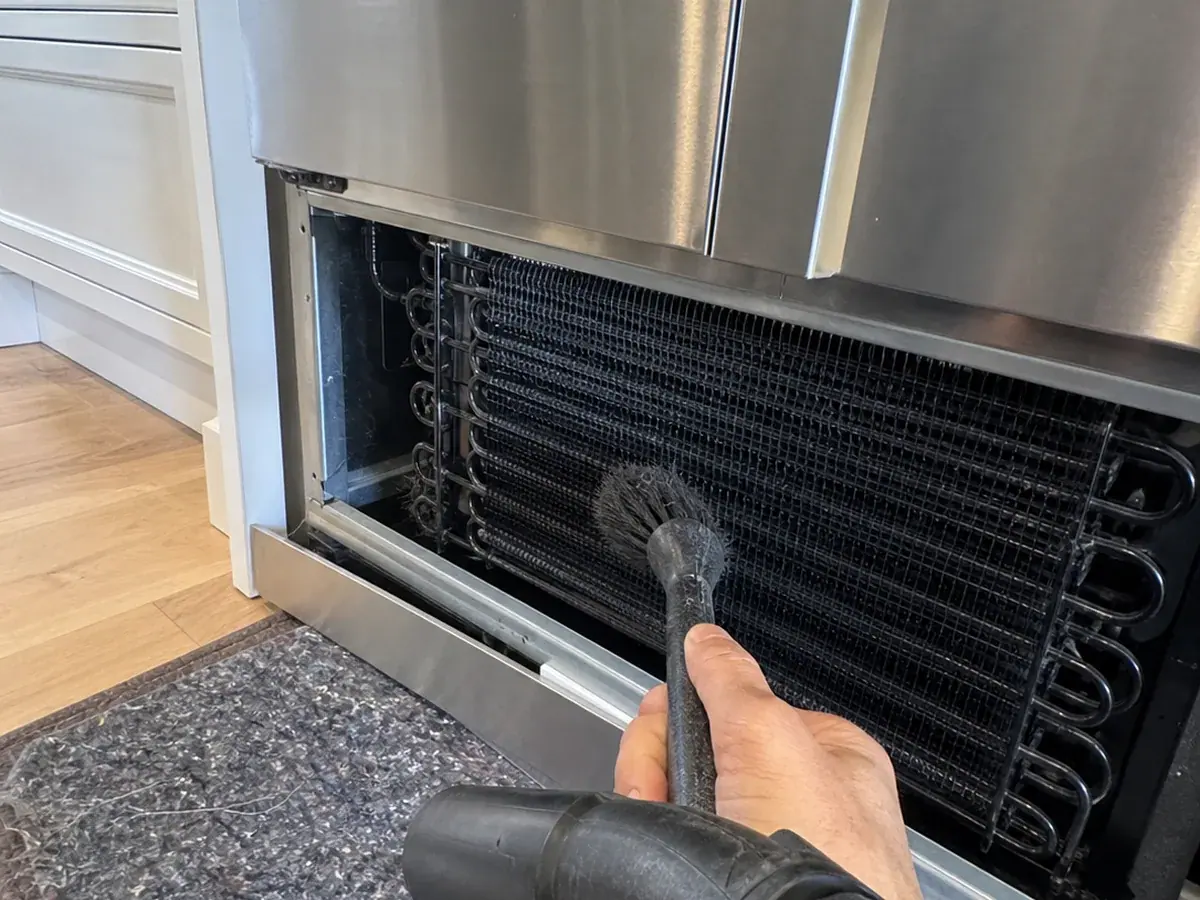
Sealed-system pressure tests normal; compressor runs; temperatures still elevated Condenser coil fouled or condenser fan underperforming Condenser coil visual and airflow check; fan motor amp draw; return-air temperature at toe-kick versus discharge temperature at top grille Assuming sealed-system fault after pressure test — if pressures are normal, the heat-rejection side (condenser) is the most likely remaining cause Condenser cleaning; OEM fan motor replacement if amp draw is low or RPM is below spec (verify by model/serial). Retest compartment temperatures.

Sealed-system price ranges

Sealed-system and compressor cost ranges in Novato

Sealed-system prices are higher because refrigerant handling, access and verification are regulated and time-intensive. The table separates simple electrical start faults from confirmed sealed-circuit work.

Sub-Zero sealed-system and compressor price table
Service / symptomWhat is includedPrice rangeTypical timing
Sealed-system diagnosticTemperature log, compressor amp draw, frost pattern, model-tag spec$95-$14560-90 min
Start relay or overload faultRelay/capacitor test, OEM start component, load retest$195-$3401-2 hr
Leak search / pressure verificationEPA-certified gauges, leak detector, written evidence$420-$7802-4 hr
Compressor replacementRecover, replace compressor, evacuate and recharge by weight$1,850-$3,3501-2 visits
Evaporator or metering-device repairOpen circuit, component replacement, pressure hold, recharge$2,100-$3,9001-2 visits
Built-in pull/reseat add-onProtect cabinetry, pull unit, relevel and document surround$260-$620 add-on1-3 hr

The final sealed-system price is set by refrigerant type, leak location, compressor family and cabinet access; no sealed-system quote is valid without on-site evidence.

EPA fact
Any Sub-Zero repair that opens the sealed refrigerant circuit requires EPA-certified handling and a recharge by specified weight.
False-positive fact
A dirty condenser or failed gasket can mimic a sealed-system fault and usually costs hundreds, not thousands, to correct.

Model-family reference

Sub-Zero Family Notes — Sealed System and Compressor

The following notes reflect patterns observed across Sub-Zero families. Where specific pressures, charge weights, or component part numbers apply, they vary by production run and must be confirmed against the unit's model and serial before any sealed-system work. Do not apply generic refrigerant charge values across families.

500-Series Built-In

Sealed-system note
Older 500-series units may use R-134a; refrigerant type and charge specification — verify by model/serial. The condenser is top-mounted; restricted airflow from the ceiling gap accelerates compressor wear on these models. Confirm minimum clearance above the grille before sealed-system diagnosis.
Common misread
Warm fresh-food section with normal freezer is frequently a defrost or damper fault, not refrigerant loss. Rule out defrost heater and thermostat before opening the sealed system.

600-Series Built-In

Sealed-system note
600-series units introduced dual compressors on some configurations — verify by model/serial whether the unit is single- or dual-circuit before pressure testing. A dual-compressor layout means each zone has an independent sealed circuit; a fault in one zone does not implicate the other.
Access consideration
Rear access on 600-series built-ins requires at least partial clearance from the surrounding cabinetry. Built-in cabinet removal/reseat risk is a real factor on these models in tight Novato kitchen remodels; plan labor time accordingly and inspect cabinetry integrity before pulling the unit.

700-Series / Designer Columns

Sealed-system note
Integrated columns use a linear or inverter compressor on some production years — verify by model/serial. Inverter compressors require a different diagnostic approach: standard LRA testing does not apply; variable-speed amp draw must be read at steady state, not startup. Using startup-LRA test procedure on an inverter compressor produces a misleading result.
Refrigerant type
Some Designer-series units use R-600a (isobutane) — a flammable refrigerant requiring specific handling procedures distinct from R-134a. Verify refrigerant type by model/serial before connecting any service equipment.

UC / UR Undercounter Drawers

Sealed-system note
Undercounter models have a compact sealed circuit and limited service port access. Refrigerant charge tolerances are tight — verify by model/serial. An overcharge on a small circuit is as problematic as an undercharge and produces similar surface symptoms (elevated compartment temperature, continuous run).
Cabinet access
UC units built into island cabinetry may require drawer removal and partial panel disassembly before the compressor is accessible. Assess cabinetry fastening before scheduling to avoid a split-visit scenario.

Diagnostic evidence

Three data points collected on every sealed-system call

1 · behind grille 2 · interior wall 3 · cabinet side MODEL + SERIAL — PHOTOGRAPH AND SEND
Model-tag evidence. The sealed-system refrigerant type, charge weight, and compressor specification are pinned to the model and serial number. We photograph the tag at the start of every visit and cross-reference it before connecting any service equipment — a critical step the reference pages for this unit confirm or override.
CONDENSER COIL FAN AIR IN (toe-kick) HEAT OUT (grille)
Condenser airflow evidence. Before any sealed-system conclusion is drawn, condenser return-air temperature is measured at the toe-kick and discharge temperature at the grille. A delta below the expected range confirms the coil is rejecting heat efficiently — eliminating condenser fouling as a cause and pointing the diagnosis toward the sealed circuit or compressor.

Local context and diagnostic evidence standard

Why marine climate and cabinet integration change the sealed-system picture

Novato's position between the San Pablo Bay and the coastal ridgeline means refrigeration equipment cycles through a narrower daily temperature swing than inland communities but accumulates sustained humidity exposure year-round. Neighborhoods near Stafford Lake Park on the western edge of town see heavier fog retention into late morning and older ranch-style homes with original kitchen footprints — cabinet openings that were sized for 1970s appliances, now holding 600-series built-ins with minimal rear clearance. That restricted airflow pushes compressor load higher, condenser coils foul faster, and what looks like a sealed-system fault at first inspection is often a condenser problem worsened by the microclimate and the cabinet geometry. From the Mount Burdell preserve foothills down through the valley floor, we find similar conditions: salt air carried inland by prevailing wind accelerates corrosion at brazed fittings and service ports, making an annual inspection of those joints a reasonable precaution on any Sub-Zero that sees that exposure.

Every sealed-system diagnostic we complete generates a documented evidence file: calibrated temperature readings logged across both compartments under steady-state and door-open recovery conditions; condenser and evaporator photos showing frost-line position and coil condition; a photograph of the model-tag proof confirming the refrigerant type and charge weight; and a record of OEM fan, gasket, and control-board evidence confirming those components were evaluated and cleared before the sealed circuit was opened. Built-in cabinet removal and reseat risk is assessed and documented before the unit is moved — surround cabinetry damage during a pull-and-reseat is a real and avoidable cost that belongs in the pre-repair conversation, not the post-repair invoice.

Check whether repair makes sense before replacing

A sealed-system diagnosis on a Sub-Zero built-in runs $95–$145 (credited to repair). We measure before quoting — refrigerant pressures, compressor amperage, and compartment recovery rate — and we show you the numbers. Call with your model number and we'll confirm which test equipment comes on the truck. Mon–Sat 7:00am–7:00pm.

Technical questions answered

Sealed system and compressor — field questions

How do you know the compressor is actually failed and not something else?

A compressor diagnosis requires LRA (locked-rotor amperage) testing, run-capacitor check, start-relay resistance, and compartment-temperature trending under load. A compressor that draws high amps but produces no head pressure has failed mechanically. One that won't start may only need a new start relay — a $40 part versus a major repair. We meter both before recommending anything.

Can a door gasket leak cause symptoms that look like a sealed-system fault?

Yes, and it happens regularly. A compromised door gasket admitting warm, humid air raises the compartment temperature and forces the compressor to run almost continuously — the same surface symptom as low refrigerant. We always perform a gasket compression test and inspect the frost-line boundary at the evaporator before attributing the fault to the sealed system. A gasket repair is a fraction of the cost.

What does EPA certification have to do with my refrigerator repair?

Sub-Zero built-ins use regulated refrigerants — typically R-134a or R-600a depending on model year. Federal law requires any technician who opens the sealed system and handles refrigerant to hold EPA Section 608 certification. We hold that certification. A shop that pressurizes or vents a sealed system without it is operating illegally and voiding any path to warranty or resale documentation.

What is the typical cost for a sealed-system repair on a Sub-Zero in Novato?

Sealed-system work on Sub-Zero built-ins in the Novato area typically runs $1,500 or more, depending on the refrigerant type, the extent of the leak, and whether access requires a full cabinet pull and reseat. We confirm the exact scope on site; no sealed-system quote is given sight-unseen. The $95–$145 diagnostic fee credits toward the repair if you proceed.

My Sub-Zero runs constantly but the compartment is only slightly warm — sealed system or condenser?

Constant running with only slight temperature drift is more likely a condenser, fan, or defrost problem than a refrigerant fault. A significant leak usually results in rapid and continuing temperature rise, not a marginal drift. We measure compartment recovery rate after a door-open event, check condenser cleanliness and fan amp draw, and evaluate evaporator frost pattern before considering the sealed system.

Is it worth repairing a sealed-system fault on an older Sub-Zero built-in?

Age, condition, and cabinetry integration all factor in. A 15-year-old unit in otherwise sound mechanical condition, built into expensive surround cabinetry, often makes financial sense to repair rather than replace — replacement can mean $8,000–$15,000 including cabinetry modification. We provide temperature logs, component photos, and a written estimate so you can compare the numbers honestly. See the repair-vs-replace guide for the full framework.

Reviews · 4.9 average from Novato & Marin customers

What customers say about sealed-system work

★★★★★

“A prior tech suspected a leak on our 648PRO because both zones were warm. These technicians cleaned the condenser, then verified low suction pressure with gauges and repaired the leak. The sealed-system work was $2,450 and held 37°F afterward.”

Verified customer
Homeowner, Ignacio Valley

★★★★★

“The compressor clicked and stopped every startup. They tested the relay first, replaced a failed start component for $285, and proved the compressor amp draw was normal. That avoided a $2,000 compressor replacement.”

Verified customer
M.G., Novato 94949

★★★★★

“Our older 532 needed a cabinet pull before pressure testing. They protected the trim, documented the model tag and found a restricted metering device. The written quote explained the $2,900 sealed-system scope before any refrigerant work began.”

Verified customer
Homeowner, Grant Avenue
Call (415) 683-1487 Book online