Skip to content
Novato Sub-Zero repair logo Sub-Zero Cold-Side ServiceAppliance Service Group of Novato · Marin / North Bay (415) 555-0125 (415) 683-1487

Home / Repair vs Replace

Built-in economics · Novato & Marin County

Sub-Zero Repair or Replace in Novato — Built-In Economics, Cabinetry & Age

4.9 Google rating47 reviews from Novato & Marin homeowners
Direct answer

The majority of Sub-Zero built-ins we diagnose in Novato — including newer kitchens around StoneTree where the appliance gets heavy daily use — have a repairable fault rather than a terminal one. The single most common finding is a condenser coil packed with dust or pet hair that prevents the unit from shedding heat; the compartment drifts warm, the compressor runs hot, and the whole situation reads like a failing unit until the coil is inspected. That is a repair. The decision becomes genuinely harder when a confirmed sealed-system fault lands on a unit past 18–20 years, or when the kitchen is already mid-remodel — and on those calls we say so plainly rather than sell a repair that may not hold. Call (415) 683-1487 with your model number and current symptom for an honest read.

A door gasket leak, condensation or a frost line along the door opening is the second pattern that brings Novato homeowners to the phone. In plain terms, warm humid room air bypasses a seal that has lost its compression, the evaporator works overtime fighting the heat load, and you notice either frost collecting at the door frame or moisture pooling below it. What confirms it is direct inspection — a compression check along the gasket profile, a look at hinge alignment and door square, and compartment temperature behavior over time. One honest limitation: a phone call cannot determine whether the gasket is the only problem or whether the cabinet opening has shifted and is pulling the door out of plane. The difference changes the scope and cost, and it takes eyes on the unit to know.

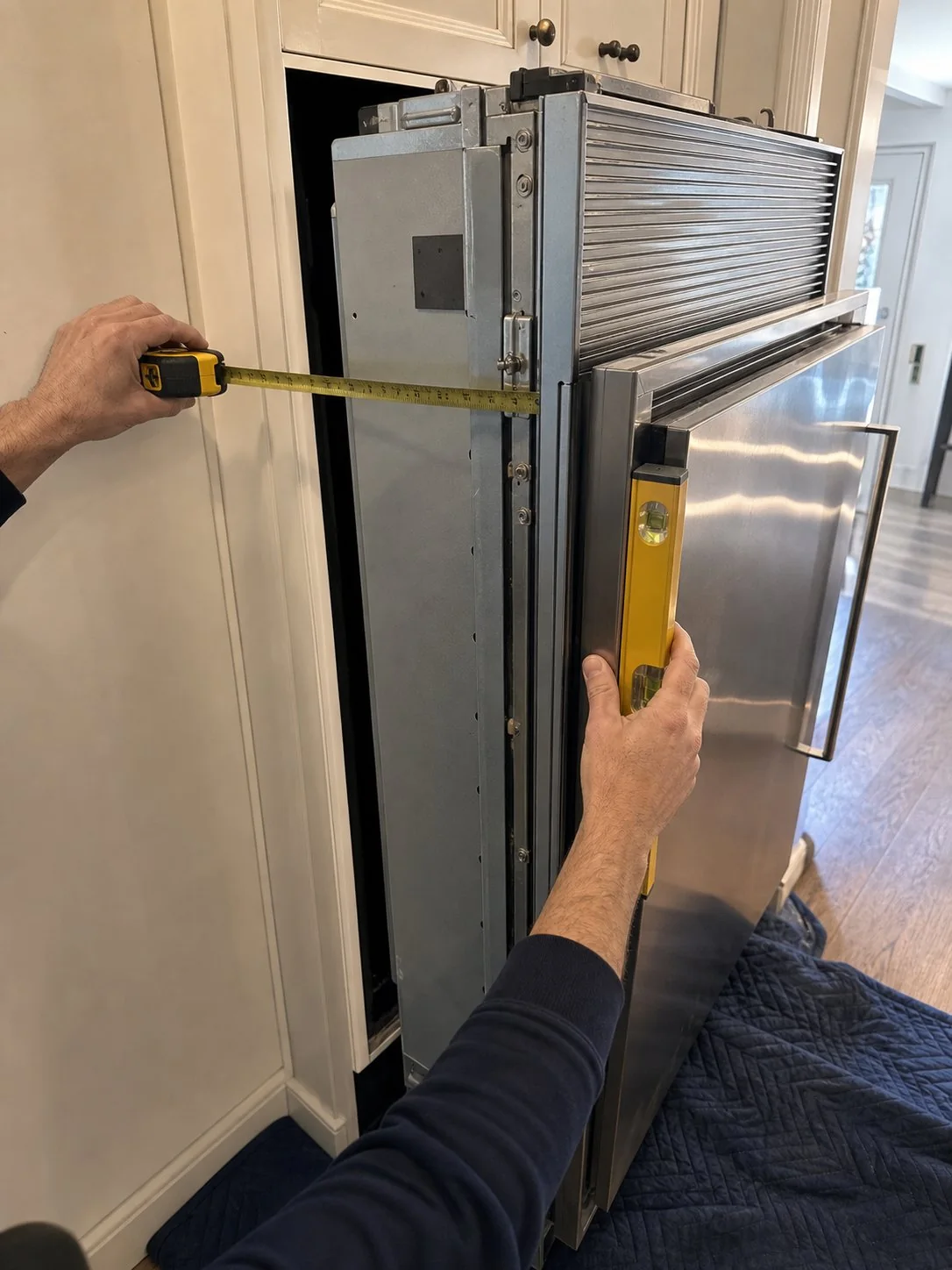
Technician hands measuring the cabinet opening around a partially pulled built-in refrigerator.
Replacement math includes the kitchen. Built-in panels, cabinet openings, and leveling work are part of the repair-vs-replace decision.

Decision framework

Six factors — which way each one points

No single factor settles the question. Run through all six; the weight of evidence tells a clearer story than any one data point.

Repair-versus-replace decision factors for Sub-Zero built-ins
Factor Leans repair Leans replace
Unit age Under 18 years — most components still serviceable, parts path open Over 22 years with a second major fault — statistical second-failure risk rises
Cabinet / remodel impact No planned remodel; existing cabinetry fits the current unit exactly Kitchen already open or new layout doesn't match the current footprint
Part availability OEM component confirmed in stock — fan, gasket, control board, ice module Compressor or board discontinued; no OEM path available
Safety No active safety flag — fault is mechanical or thermal, not electrical burn or refrigerant leak indoors Confirmed refrigerant leak into living space or active burn fault on the board
Repair cost Repair is under 40% of replacement total (appliance + cabinetry) Repair cost approaches or exceeds 60% of replacement total on an older unit
Replacement disruption Disruption is low — standard footprint, panel-ready swap possible Built-in requires countertop cut, custom cabinetry or stone modification to replace

The table weights replacement disruption deliberately

In Novato kitchens — especially tighter Marin County remodels — the cabinetry and stone work around a Sub-Zero built-in can cost $4,000–$10,000 on top of the appliance. That total belongs on the replace side of any comparison, not hidden in a separate contractor quote.

Brand economics

Why Sub-Zero built-ins have different economics from mass-market refrigerators

A mass-market side-by-side at the $1,200 price point is disposable by design. When the sealed system fails at year nine, replacement is straightforward — it slides out, the new one slides in, and the cabinet opening was built loose to accept whatever brand fits. The math is simple. A Sub-Zero 600-series or Designer column built into custom cabinetry operates under entirely different constraints. The appliance was specified to a fraction of an inch. The panel overlay was fabricated to match the surrounding millwork. In many Marin County kitchens, the unit sits against stone countertops that would need to be notched or replaced to accommodate a different footprint. That context does not mean repair always wins — but it does mean the replacement cost is not $10,000. It is often $14,000–$22,000 by the time the kitchen trades finish, and that number is the honest comparator against a repair estimate.

At the same time, repair does not always win, and it is worth being direct about when it should not. A 24-year-old unit with a corroded evaporator, a second compressor fault and a control board on back-order is a genuine replacement case — not because the brand has failed you, but because the repair investment is unlikely to return value over the unit's remaining service horizon. Similarly, if you are already mid-remodel and the new kitchen layout no longer accommodates the original footprint, replacement is the logical path regardless of the unit's mechanical condition. The decision is financial and logistical, not brand loyalty.

Where Sub-Zero's construction genuinely matters to the economics: the units are built to a serviceability standard that mass-market appliances rarely match. Sealed systems are designed to be accessed and repaired. Control boards are modular. Gaskets are available in multiple profiles to match decades of production variants. A 14-year-old 648 with a failed condenser fan is a well-supported repair that, all told, might cost $350–$550 and extend useful service life by five to eight years on a platform worth $12,000 new. That math is hard to argue against. A 21-year-old 532 with a leaking compressor is a harder conversation, and we will have it honestly.

Typical situations

Three Novato homeowner situations — how the decision landed

Three common repair-or-replace situations we see on Sub-Zero built-ins around Novato, and how the numbers pointed each one. Your own outcome depends on the unit's age, condition, fault and kitchen configuration.

StoneTree — 600-series, 11 years old, running warm

Symptom
Fresh-food section drifting to 48–50°F; freezer still holding. Homeowner suspected compressor.
Finding
Condenser coil packed with dust and pet hair; fan moving restricted air. No sealed-system fault.
Decision
Repair — condenser clean and fan motor replacement. Total cost well under $600. Unit returned to spec temperature within two hours.
Why replace was not the call
Unit age, confirmed mechanical-only fault, intact cabinetry surround and full OEM part availability all pointed the same direction.
Not-cooling diagnostic path →

Bel Marin Keys — 700-series column, 17 years old, frost at door frame

Symptom
Frost accumulating at the bottom of the door opening; occasional condensation on the cabinet face. Unit cycling frequently.
Finding
Door gasket had taken a permanent compression set. Secondary finding: hinge was marginally out of adjustment, contributing to inconsistent seal pressure at the top corner.
Decision
Repair — gasket replacement in the correct profile for that column, hinge adjustment. Cabinet surround was intact; no disruption required.
Why replace was not the call
A 17-year-old integrated column with a confirmed gasket fault and no sealed-system indication is a straightforward repair. Bel Marin Keys homes with waterfront exposure often accelerate gasket wear through humidity cycling, which makes the fault common but does not make the unit unserviceable.
Gasket repair details →

San Rafael (adjacent service area) — 500-series, 23 years old, warm throughout

Symptom
Both compartments running 10–12°F above setpoint. Compressor running but not cycling off. No condenser fault found after cleaning.
Finding
Sealed-system suspicion confirmed by temperature readings, evaporator frost pattern and pressure data. Compressor showing reduced capacity. OEM compressor available but lead time was three weeks.
Decision
Honest split recommendation — sealed-system repair quoted at approximately $1,600 with parts. Given unit age (23 years), second-fault probability and the homeowner's planned kitchen refresh in 18 months, replacement was the more logical path. Technician said so directly; homeowner chose to wait and replace during the remodel rather than invest in the repair.
Why replace was the honest call
Unit age plus confirmed sealed-system fault plus planned remodel equals a scenario where the repair investment would likely not be recovered in useful service life before the kitchen work disrupted everything anyway.
Sealed-system diagnostic →

Repair economics - confirm by phone

Typical cost reference for Novato Sub-Zero repairs

Compare the repair to the real replacement total: appliance, panel work, cabinet modification and any stone/countertop trade needed to fit a new built-in.

Repair versus replacement cost table for Novato built-ins
Service / symptomWhat is includedPrice rangeTypical timing
Diagnostic assessmentOn-site data, model-tag year, component tests and written recommendation$95-$14545-90 min
Repair-favored faultsCondenser clean, fan, gasket, thermistor, defrost or ice module$245-$7801-5 hr
Higher repair bandControl board, panel-door alignment or combined gasket/condenser work$585-$1,400Same day to 1 visit
Sealed-system exceptionEPA-certified compressor, leak or metering-device repair$1,650-$3,900+1-2 visits
Replacement appliance onlyNew Sub-Zero built-in, before local trades$9,500-$17,500Order-dependent
Replacement with Marin cabinetryAppliance, custom panel, cabinet modification, possible stone work$13,500-$23,500+Weeks, not hours

The final decision turns on unit age, fault type, parts path and whether the kitchen is already being remodeled.

Decision fact
Under 18 years old with a repairable component fault usually favors repair once Novato cabinetry disruption is priced in.
Replace fact
A unit over 22 years old with a second sealed-system fault and no remodel fit advantage is the clearest replacement case.

How we arrive at the recommendation

Evidence behind the assessment, not a sales pitch

Any repair-versus-replace opinion is only as good as the evidence behind it. When a call tips toward a sealed-system suspicion that needs EPA-certified verification, we do not guess — we build the case from temperature readings across both compartments, condenser and evaporator photos that show the frost pattern, model-tag proof that confirms the exact sealed-system spec and production year, and OEM fan, gasket and control-board checks that clear the cheaper components first. That evidence trail is what separates a genuine sealed-system conclusion from a misdiagnosed condenser fault that cost someone an unnecessary compressor quote.

The same standard applies to replacement recommendations. We name the specific findings — age, fault type, second-failure probability, parts availability — so you can evaluate the logic rather than take our word for it. A technician who shows their work is the only kind worth calling when the decision involves $1,500 either way.

1 · behind grille 2 · interior wall 3 · cabinet side MODEL + SERIAL — PHOTOGRAPH AND SEND
Model-tag locations on Sub-Zero built-ins. The tag behind the grille, on the upper interior wall or on the cabinet side pins the sealed-system spec, parts availability and production year — the three data points that most directly shape the repair-versus-replace call.

Send the symptom and a model-tag photo

The model number and what the unit is doing right now give us more usable information than a general description. Send both — symptom and model tag — and we can tell you whether this looks like a repair call, a sealed-system assessment or a situation where replacement deserves to be on the table. No commitment required; honest answer guaranteed. (415) 683-1487 · Mon–Sat, 7:00am–7:00pm.

Repair vs replace — common questions

Sub-Zero repair-or-replace FAQ

At what age does replacing a Sub-Zero built-in make more sense than repairing it?

There is no single number, but a unit past 20 years with a confirmed sealed-system fault — compressor or refrigerant — sits in genuinely uncertain territory. Parts availability narrows, and a second major repair is statistically more likely on an older platform. Under 18 years, with a repairable component fault (fan, gasket, control board), repair is almost always the better economic move once cabinetry disruption is priced into replacement.

How much does it cost to replace a Sub-Zero built-in in Novato including cabinetry?

The appliance alone runs roughly $8,000–$16,000 depending on configuration. Add cabinet modification, panel remaking or stone countertop adjustment and the total often reaches $12,000–$22,000 or higher in Marin County kitchens. That context matters when evaluating a $900–$1,400 repair on an otherwise sound unit. Replacement disruption cost should always sit on the replace side of any comparison.

Can you repair a Sub-Zero sealed system, or does that always mean replace?

Sealed-system faults do not automatically mean replace. A compressor or refrigerant repair on a well-maintained 12- to 16-year-old built-in can be sound economics when the unit is structurally solid and parts are available. What it requires is EPA-certified refrigerant handling and an honest diagnosis — not an assumption. We confirm with temperature readings, evaporator frost pattern and pressure data before quoting.

What Sub-Zero problems clearly favor replacement over repair?

A unit over 22 years old with a second major sealed-system failure, a corroded evaporator, or an obsolete control board with no OEM path is a realistic replacement case. So is a situation where the homeowner is already remodeling the kitchen and the current unit's footprint no longer fits the new cabinetry plan. We will say so plainly rather than sell a repair that won't last.

Do you charge for the repair-versus-replace assessment?

The diagnostic fee ($95–$145) covers the on-site evaluation, which is where the real data comes from — compartment temperatures, component tests, model-tag confirmation and a frank opinion on the unit's remaining service life. That fee credits toward the repair if you proceed. We do not charge separately for the replace recommendation when the evidence points that way.

Does a condenser coil packed with dust or a door-gasket leak always mean repair?

Those faults strongly favor repair — they are mechanical and parts-driven, not structural. A condenser coil packed with dust or a door gasket leak confirmed by inspection are among the most cost-effective Sub-Zero repairs available. The exception is when those symptoms appear on a unit already showing a deeper sealed-system fault underneath; that is why we test both before recommending.

Reviews · 4.9 average from Novato & Marin customers

What customers say about our repair-or-replace advice

★★★★★

“I expected to replace a 17-year-old 700-series column after frost showed up at the door. They priced the actual gasket and hinge repair at $585 versus a $16,000 replacement path, fixed it, and it held 38°F.”

Verified customer
Homeowner, Bel Marin Keys

★★★★★

“Our Designer column had a board alarm and I worried about a full replacement. They confirmed the board revision from the model tag, replaced it for $720, and showed why replacement with panel work would have exceeded $18,000.”

Verified customer
P.S., Pointe Marin

★★★★★

“The 23-year-old built-in had a confirmed compressor fault and a kitchen refresh planned. Their sealed-system quote was about $2,600, but they explained the second-failure risk and recommended waiting for replacement during the remodel.”

Verified customer
Homeowner, Novato 94945
Call (415) 683-1487 Book online